
OpenAI Introduces New Enterprise AI Features to Help Businesses Improve Productivity and Collaboration
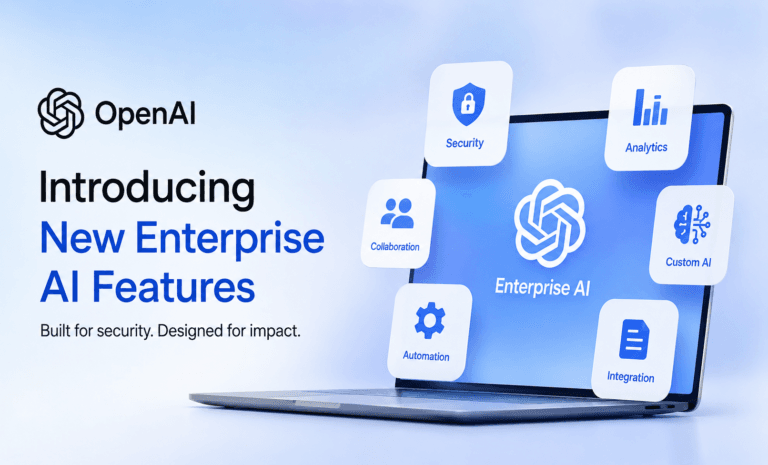
OpenAI has announced new enterprise-focused artificial intelligence capabilities designed to help organizations improve productivity, streamline workflows, and enhance collaboration. The latest updates reflect the growing role of AI in the workplace, where businesses are increasingly adopting intelligent tools to automate routine tasks, support decision-making, and improve operational efficiency.
The newly introduced enterprise features are aimed at organizations looking to integrate AI into their daily operations while maintaining high standards of security, governance, and scalability. As businesses across industries continue to accelerate their digital transformation initiatives, enterprise AI has become an important investment for improving employee productivity and delivering better customer experiences.
According to OpenAI, the latest enhancements expand the platform’s ability to support enterprise customers through improved collaboration tools, workflow automation, administrative controls, and integration capabilities. These additions enable organizations to deploy AI more effectively across multiple departments while maintaining centralized management and oversight.
Growing Demand for Enterprise AI
Artificial intelligence has rapidly evolved from an emerging technology into a core business tool. Organizations worldwide are now using AI to automate repetitive tasks, generate business reports, summarize meetings, create content, analyze data, and improve customer support.
Research from leading industry analysts indicates that enterprise AI adoption continues to grow as companies seek technologies that can improve efficiency without increasing operational costs. Businesses are also investing in AI to accelerate innovation, strengthen decision-making, and help employees focus on higher-value work.
OpenAI’s latest enterprise capabilities align with these trends by providing organizations with flexible tools that can be integrated into existing business workflows.
Enhanced Security and Administrative Controls
One of the key areas of focus in the latest release is enterprise security.
Businesses adopting AI often require centralized administration, user management, and governance policies to ensure that sensitive information remains protected. The updated enterprise capabilities include stronger administrative controls that allow organizations to manage users, assign permissions, and oversee AI usage across teams.
These improvements are designed to support businesses operating in regulated industries where compliance, privacy, and data protection remain essential considerations.
Custom AI for Business Knowledge
Another notable enhancement is the ability for organizations to create AI assistants tailored to their own business knowledge.
Rather than relying solely on general information, enterprises can develop AI tools that help employees access approved internal documentation, company policies, project information, and organizational knowledge. This enables faster information retrieval while supporting consistency across departments.
Custom AI solutions can assist employees in answering internal questions, generating documentation, preparing reports, and supporting day-to-day operations.
Workflow Automation Across Teams
The latest enterprise features also expand AI-powered workflow automation.
Businesses can use AI to assist with:
- Drafting business emails and communications
- Summarizing meetings
- Organizing project documentation
- Preparing reports
- Research assistance
- Content generation
- Knowledge management
- Administrative task automation
By reducing repetitive manual work, organizations can allow employees to dedicate more time to strategic initiatives, creative problem-solving, and customer engagement.
Integration with Existing Business Tools
OpenAI continues to expand integration capabilities with commonly used enterprise software.
Organizations increasingly rely on collaboration platforms, customer relationship management systems, productivity applications, and internal knowledge bases. AI integration enables businesses to incorporate intelligent assistance directly into existing workflows without significantly changing established processes.
This flexibility helps organizations accelerate AI adoption while minimizing disruption.
AI Adoption Across Industries
Enterprise AI is no longer limited to technology companies.
Healthcare organizations are exploring AI to improve administrative efficiency and documentation. Financial institutions are implementing AI for fraud detection, customer service, and risk analysis. Manufacturers are using intelligent automation to optimize production planning and predictive maintenance. Retail businesses are leveraging AI to personalize customer experiences and improve inventory management.
Legal, education, logistics, marketing, and consulting firms are also expanding their AI investments as demand for intelligent business solutions continues to increase.
Supporting Hybrid Work
As hybrid and remote work remain common across many industries, AI continues to play an important role in helping distributed teams collaborate more effectively.
AI-powered meeting summaries, document creation, research assistance, and project planning tools enable employees to stay informed and productive regardless of their location.
Organizations are increasingly viewing AI as a collaborative workplace assistant rather than simply an automation tool.
Responsible AI Remains a Priority
Alongside productivity improvements, responsible AI deployment remains an important focus.
Businesses evaluating AI solutions continue to prioritize transparency, governance, privacy, and security. Enterprise-grade administrative controls help organizations establish internal policies while maintaining oversight of AI usage across departments.
As enterprise AI adoption grows, governance frameworks are expected to play an increasingly significant role in ensuring responsible implementation.
Looking Ahead
Industry experts expect enterprise AI investment to continue growing over the next several years as organizations seek competitive advantages through intelligent automation and data-driven decision-making.
The latest enterprise features introduced by OpenAI demonstrate the ongoing evolution of AI from a standalone technology into a practical business platform supporting productivity, collaboration, and innovation.
Organizations that successfully integrate AI into everyday workflows while maintaining appropriate governance and security measures are likely to benefit from increased efficiency and improved operational performance in the years ahead.
About OpenAI
OpenAI is an artificial intelligence research and technology company that develops advanced AI models and products for consumers, developers, and enterprises. Its technologies are used across industries to support productivity, software development, research, customer engagement, and business innovation.
Source
This article is based on publicly available information from OpenAI’s official website and announcements. It has been prepared by the editorial team at Leaders Vision Magazine for news and informational purposes and is not an official press release issued by OpenAI.