
AI Agents vs. AI Chatbots: What’s the Difference in 2026?
AI Agents vs. AI Chatbots: What’s the Difference in 2026?
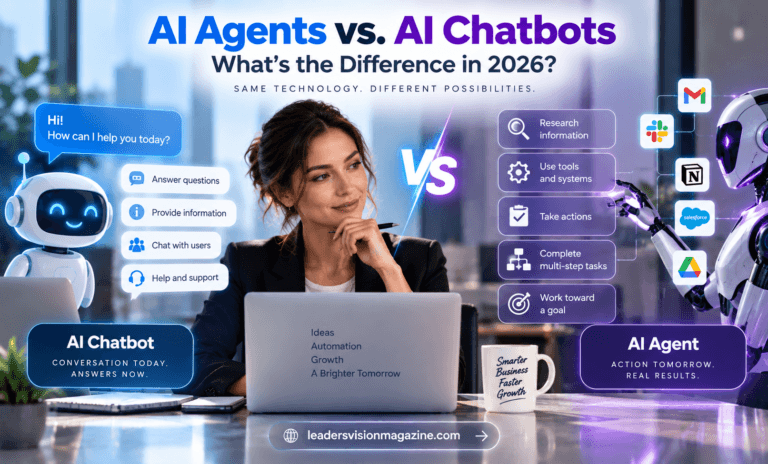
Artificial intelligence is moving beyond simple question-and-answer conversations.
Businesses are now using AI to answer customers, summarize information, create content, analyze documents, automate workflows, and in some cases complete multi-step tasks with limited human intervention.
That shift has made two terms increasingly common: AI chatbots and AI agents.
Although they sound similar, they are not exactly the same.
An AI chatbot is generally designed to communicate with a person and respond to prompts or questions. An AI agent can go further by planning actions, using connected tools, interacting with software, and working toward a defined objective.
So, what is the difference between AI agents and AI chatbots in 2026, and which one does a business actually need?
What Is an AI Chatbot?
An AI chatbot is a software system designed to communicate with users through natural language.
A customer might ask:
“What are your business hours?”
The chatbot can understand the question and provide an answer.
Modern AI chatbots can handle much more sophisticated conversations than traditional rule-based bots. They can draft responses, summarize information, answer questions, explain products, and help employees find information.
Common uses for AI chatbots
Businesses can use chatbots for:
- Customer support
- Frequently asked questions
- Lead qualification
- Website assistance
- Employee questions
- Content generation
- Product information
- Basic troubleshooting
- Appointment or inquiry assistance
The key idea is simple:
A chatbot primarily interacts with people through conversation.
What Is an AI Agent?
An AI agent is designed to accomplish a goal by taking actions, often across multiple steps.
Instead of simply answering:
“What is my order status?”
an agent could potentially retrieve the order information from a connected system, determine its status, and provide the appropriate response.
Depending on the system and permissions available, an AI agent may be able to interact with software, retrieve information, make decisions within predefined rules, and execute parts of a workflow.
Examples of AI agent tasks
An AI agent could potentially help with:
- Researching information
- Updating CRM records
- Processing routine requests
- Preparing reports
- Organizing information
- Managing workflow steps
- Monitoring specific business processes
- Supporting sales operations
- Handling certain customer-service tasks
- Connecting multiple business applications
The important distinction is that an agent is generally designed around action and task completion, not just conversation.
AI Chatbot vs. AI Agent: The Main Difference
The simplest way to understand the difference is:
AI chatbot = primarily responds.
AI agent = can reason through a task and take actions toward a goal.
There is overlap between the two.
A sophisticated chatbot may be connected to business systems and perform certain actions. Likewise, an AI agent may communicate with users through a chatbot-style interface.
The difference is therefore not always a strict technical boundary.
Instead, it is useful to think about the level of autonomy and action involved.
| Feature | AI Chatbot | AI Agent |
|---|---|---|
| Answers questions | Yes | Yes |
| Conversational interaction | Yes | Often |
| Generates content | Often | Often |
| Uses external tools | Sometimes | Commonly |
| Performs multi-step tasks | Limited | Designed for this |
| Takes actions | Limited | Often |
| Works toward a defined goal | Limited | Yes |
| Requires human oversight | Usually | Recommended |
| Workflow automation | Basic to moderate | Advanced |
How an AI Chatbot Works
A typical AI chatbot follows a relatively straightforward process.
1. A user asks a question
The user enters a message through a website, application, or other interface.
2. The AI interprets the request
The system analyzes the user’s language and determines what information or response may be appropriate.
3. The AI generates an answer
The chatbot produces a response based on its available model, instructions, and connected information.
4. The conversation continues
The user can ask another question, and the chatbot continues the interaction.
For many customer-service and information-based tasks, this is enough.
How an AI Agent Works
An agent-based workflow can involve additional steps.
Imagine a business owner asks:
“Find our highest-value customers from last quarter and prepare a summary for tomorrow’s sales meeting.”
An agent could potentially:
- Interpret the objective.
- Access an authorized data source.
- Retrieve relevant customer information.
- Analyze the data.
- Identify the highest-value customers.
- Create a summary.
- Prepare the result in a requested format.
The exact capabilities depend on the agent’s tools, permissions, integrations, instructions, and safeguards.
This is what makes agents particularly interesting for business automation.
Why AI Agents Matter for Small Businesses
Small businesses often have employees performing repetitive processes manually.
For example:
- Copying information between systems
- Preparing recurring reports
- Sorting customer inquiries
- Updating records
- Researching prospects
- Creating routine documents
- Following up on standard requests
If an AI agent can safely handle portions of these workflows, employees may spend less time on repetitive administrative work.
However, automation should not be introduced simply because something can be automated.
The business should first determine whether automation is actually valuable.
AI Agents Are Not Completely Autonomous Employees
One common misconception is that an AI agent is essentially a digital employee that can do anything.
That is not how businesses should approach the technology.
AI systems can make mistakes. They can misunderstand instructions, use incorrect information, or produce an inappropriate action.
For that reason, businesses should establish:
- Clear permissions
- Human approval for sensitive actions
- Data-access controls
- Monitoring
- Testing
- Error-handling procedures
- Escalation processes
The more consequential the action, the more important human oversight becomes.
Which Is Better: AI Agents or AI Chatbots?
Neither is automatically better.
The right technology depends on the problem.
Choose an AI chatbot when:
Your primary need is communication.
For example:
- Answering customer questions
- Explaining products
- Providing basic support
- Helping website visitors
- Responding to frequently asked questions
Consider an AI agent when:
Your primary need is completing a workflow.
For example:
- Gathering information from multiple systems
- Automating repetitive processes
- Preparing recurring reports
- Updating business systems
- Coordinating multiple workflow steps
In many businesses, the answer may actually be both.
A chatbot can be the conversational interface, while an agent handles the underlying workflow.
AI Chatbots and AI Agents Can Work Together
Consider an ecommerce company.
A customer enters:
“I need to change the delivery address for my order.”
The chatbot can understand the customer’s request and communicate with them.
Behind the scenes, an agent or automated workflow could potentially:
- Verify the order.
- Check whether the order is eligible for an address change.
- Access the appropriate system.
- Update the information if permitted.
- Confirm the change with the customer.
The customer experiences a conversation.
The business experiences an automated workflow.
This combination is one reason the distinction between chatbots and agents can sometimes become blurry.
What Should Business Leaders Consider Before Using AI Agents?
AI agents can be powerful, but businesses should evaluate them carefully.
1. What problem are you solving?
Start with the business problem rather than the technology.
Do not automate a process simply because an AI tool exists.
2. How risky is the task?
A system drafting a low-risk internal summary is very different from a system making financial, legal, medical, or customer-account decisions.
High-impact workflows require stronger controls.
3. What data will the AI access?
Businesses should understand what information an AI system can access and what permissions it has.
4. Where should human approval be required?
Not every task needs manual approval.
But important or irreversible actions may require a human checkpoint.
5. How will performance be measured?
Businesses should define success before launching an automation.
Possible measurements include:
- Time saved
- Cost reduction
- Response time
- Error rate
- Customer satisfaction
- Employee productivity
- Conversion rate
The Future of Business AI
The evolution from chatbots toward more capable AI agents could change how businesses interact with software.
Instead of employees manually opening several applications and completing a series of repetitive steps, future workflows may increasingly involve AI systems coordinating portions of those processes.
That does not mean every business needs a fully autonomous AI workforce.
In many cases, the most valuable approach will be more practical:
People make important decisions. AI handles appropriate repetitive work.
That model can allow businesses to improve efficiency without giving an AI system unlimited authority.
AI Agents vs. AI Chatbots: Frequently Asked Questions
Are AI agents the same as AI chatbots?
No. They overlap, but an AI chatbot primarily focuses on conversational interaction, while an AI agent is generally designed to accomplish tasks and take actions using available tools and systems.
Can a chatbot become an AI agent?
A conversational AI system can be connected to tools and workflows that allow it to perform actions. At that point, it can have agent-like capabilities.
Are AI agents safe for businesses?
They can be used safely when businesses implement appropriate permissions, monitoring, testing, security controls, and human oversight. The level of control should match the potential impact of the actions being performed.
Do small businesses need AI agents?
Not necessarily. A small business should first identify repetitive or time-consuming workflows. A chatbot may be enough for customer questions, while an agent may be useful for more complex workflows.
Will AI agents replace employees?
AI agents can automate portions of certain jobs, particularly repetitive tasks. However, businesses still need people for leadership, judgment, creativity, relationship-building, accountability, and decisions requiring context.
Final Verdict
The difference between an AI chatbot and an AI agent comes down largely to what the system is expected to accomplish.
A chatbot is primarily built to communicate.
An AI agent is designed to work toward a goal and potentially perform multiple actions along the way.
For businesses in 2026, the biggest opportunity may not be choosing one over the other. It may be finding practical ways to combine conversational AI, automation, and human decision-making.
The smartest strategy is to start with a real business problem, test the technology on a controlled workflow, measure the results, and expand only when the benefits are clear.
AI should make a business more capable—not simply more complicated.