
Mike Sedita: The Man Who Learned to Read the Room
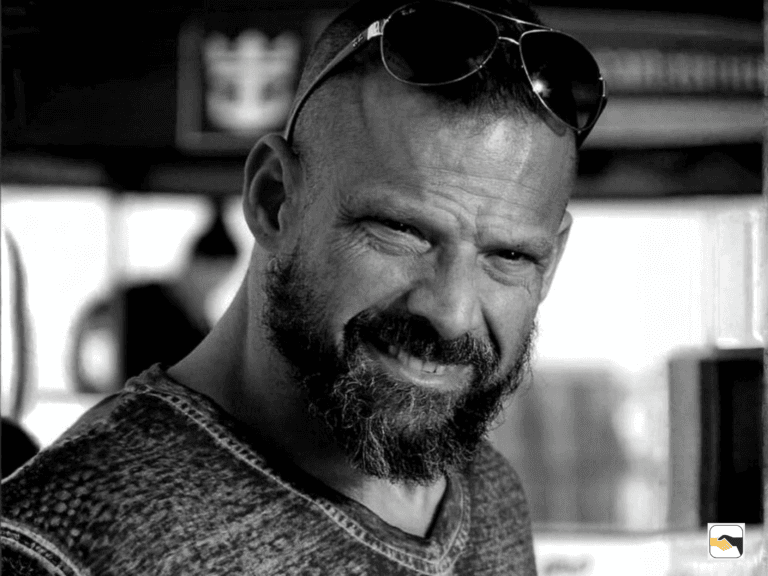
Mike Sedita has been told no his whole life. He built a career on learning what it actually meant.
Influential People of 2026
There is a photograph of Mike Sedita at twelve, standing at a Little League plate in Wood-Ridge, New Jersey, in a jersey that is visibly not his. It hangs past his shorts. His face is set somewhere between a grin and a snarl.
The league could not get a uniform big enough for him, so his coach took off his own and handed it across the bench.
What happened next opens Sedita’s first book, out this December, and it is the kind of scene that explains a person in ninety seconds. The man on the public address system — three hundred pounds himself, still sore that Sedita had picked a rival team over his — leaned into the microphone as the boy stepped in:
Now batting, wearing his coach’s jersey, Mike Sedita.
His mother was working the concession stand directly below the booth. Before the pitcher could come set, she had rounded the dugout, taken the stairs two at a time, and cornered the announcer inside the press box with her finger in his chest. The microphone was off. The whole field heard her anyway.
Two days later the custom jersey arrived. He never had to ask who made the call.
The résumé, briefly
Sedita is fifty-four. He is a performance coach for Best Version Media, where he trains new publishers across the country to launch community magazines and build local media businesses of their own. Before that he sold advertising. Before that, Fords on a lot in Smyrna, Georgia, and — at twenty-two, broke, working nights — sports picks out of a phone room in an Atlanta office park.
In between, six years running operations inside a Manhattan financial firm. He left college two semesters short of a degree and spent thirty years working as though somebody were about to bring it up. Nobody ever did.
At twenty-nine he weighed three hundred and ninety-five pounds. Seven months after gastric bypass surgery he weighed one hundred and seventy-five, and spent the next two decades finishing what one operation started — six more surgeries, and a body he had to learn twice.
He joined Best Version Media in 2021 and could not close a single account for forty-five days. He became a Million Dollar Producer in his first full year, and in December 2023 recorded the largest single sales month in the company’s history — a record he still holds. In 2025 he signed his own advertising agency over to his wife in order to take a full-time coaching role, because company policy would not permit him to hold both.
He lives in Apollo Beach, Florida with his wife Kacey, his stepsons Ethan and Evan, a golden doodle named Maggie, and a white English bulldog named Norman.
Norman is relevant. We will come back to him.
What he actually teaches
Ask Sedita what he does and he will say he teaches people how to walk into a room and ask for something. Ask what he knows about branding — the subject he is most often booked to speak on — and he tells you a story about his dog.
What follows is adapted from his book.
THE BULLDOG ARGUMENT
Here is the best proof I have that any of this works, and it has nothing to do with me.
After a bad breakup I moved into a rental house in Wesley Chapel — in one of the neighborhoods my own magazine served. This was September, a few weeks before I met my wife, and I was about as low as I get.
Norman gets walked exactly one house in either direction, because he is a bulldog and that is his whole position on exercise. So that’s what we did.
And one afternoon there’s a knock at my door, and it’s a kid. Maybe eight years old. His name was Ace.
He doesn’t say hello. He doesn’t introduce himself. He looks up at me and says: “You’re Norman’s dad.”
I said I was. I asked him how he knew Norman.
And he said: “He’s in the magazine every month.”
So I brought Norman out and let that kid sit on my front lawn and pet my dog.
Five minutes after he left, another knock. It’s his little sister. She’s about four. She doesn’t say hello either.
“My brother got to play with Norman. I want to play with Norman.”
So Norman went back outside and did it all again, which for him means lying down and permitting it. Then their mother came down the block, and what she said to me was this: we knew when you moved in that that was Norman. The kids love him. We were waiting for a chance to come introduce ourselves.
A family in that neighborhood had recognized my dog before they’d ever met me — because he’d been in a magazine, in their mailbox, every month, for years.
I asked whether they’d ever thought about being on the cover.
They ended up on the cover January 2025.
That is the entire business, demonstrated by a bulldog. Consistency makes you familiar. Familiar makes you trusted. Trusted means a stranger’s eight-year-old knocks on your door.
I have explained that to business owners in a hundred appointments. I have never once explained it as well as Norman did by lying on a lawn.
The part most people get backwards
Sedita’s central argument about marketing is not about logos or color palettes. It is the difference between describing yourself and describing your customer — and he makes the case with an ad he rewrote for a restaurant client who was about to fire him.
Her original said what nearly every small business ad says. Fresh ingredients. Family owned. Serving the community eighteen years. All true. None of it working.
He asked for one more shot. What ran instead:
Hey Mom — too tired to cook tonight? Come let our family cook for your family.
A QR code underneath, half off an appetizer. Tables filled on Tuesday and Wednesday nights. She renewed without hesitation.
“Her ad talked about the restaurant,” he says. “Mine talked to one specific exhausted woman at five o’clock on a Tuesday who has already opened the refrigerator twice and has about eleven minutes before somebody asks her what’s for dinner.”
He traces it to a Ford lot in Georgia in 1996, when he stopped reciting horsepower to a young couple and simply parked the vehicle beside their rusted-out sedan so they could see what their own driveway ought to look like.
“You never sell features,” he says. “You sell the future state.”
Naming it first
The other technique Sedita is known for is less a tactic than a disposition, and it has been with him since the borrowed jersey.
In the spring of 1989, at seventeen, he ran for student council president against a candidate running unopposed — the sitting vice president, captain of the cheerleaders, straight-A student. He had three days and never hung a poster.
Five hundred students in the auditorium. He opened like this:
I know I’m not the most popular guy in this school. I’m not the best looking. I’m not the captain of the cheerleaders. I’m not the smartest person in this room. But if you elect the regular guy, here’s what I’ll do.
It was a landslide.
Thirty-two years later, walking into a conference room full of the top producers in his new company having sold nothing at all, he introduced himself as Modest Mike. The room came apart. He won Newcomer of the Year.
“An objection loses all of its power the second the person it’s about says it out loud first,” he says. “Whatever you’re hoping nobody brings up in your next meeting — you say it. In the first ninety seconds. It stops being a weapon the moment it’s yours.”
What the book is actually about
Built for the Objection is not a business book. It is a memoir, and an unusually unguarded one — about a body, three marriages, and a four-year stretch in which Sedita buried a brother, a mother, and a father while moving three households and holding a business together with both hands.
Today he is two hundred and nineteen pounds at fourteen percent body fat, and he will tell you there is one more surgery he still wants.
The through line is the word no, and what he eventually learned to do with it.
“Every one of those people handed me a piece of paper with something true written on it,” he says. “My only job was to open it and read it, instead of taking it personally and throwing it away. It took me until my fifties to work that out.”
He is clear-eyed about the limits of the lesson. Those forty-five days without a sale ended only when his division leader asked him two questions — Are you active? Are you doing it the right way? — and he gave the honest answer: not exactly.
“The single most valuable thing I ever did in business was surrender,” he says. “I had to put down the thing I was best at and do it somebody else’s way, on purpose, until it worked.”
Built for the Objection is available December 2026.