
Sumanta Roy: Driving Innovation, Transformation, and Purpose in a Digital World
Des Linden, an Olympic athlete and Boston Marathon champion, will soon receive a virtual replica of her heart – a real-time, digital twin that mirrors its activity, performance, and stress response. In a parallel development, the Jaguar Formula E Racing Team is deploying similar technology to optimize the engines of its high-performance race cars. What’s the connection between a world-class athlete and a racing machine?
At the core, it’s about the heart. One biological. One mechanical. Both are critical engines of performance. Both are now being simulated in digital environments to push boundaries, measure efficiency, and enhance outcomes. This is not fiction. This is the reality of digital twin technology, and Tata Consultancy Services (TCS) is at the forefront of it all.
Digital twin technology offers virtual models of real-world entities, whether mechanical or biological. It allows for testing, monitoring, and analyzing without touching the physical object. In Des Linden’s case, it enables non-invasive heart monitoring to enhance health outcomes. For Jaguar, it means testing racing conditions virtually, improving design, speed, and performance.
The common enabler? TCS. The company has been a key partner in both the Living Heart Project, in collaboration with Dassault Systèmes, and Jaguar’s push into electric vehicle performance innovation. TCS continues to redefine the impact of technology on both individual well-being and industrial performance.
TCS: A Legacy of Disruption Since 1968
Established in 1968, TCS has grown into one of the most valuable IT services brands globally. With operations in more than 55 countries and a 600,000-strong workforce, TCS offers unmatched contextual knowledge across industries, enabling it to offer transformative business solutions tailored to local and global challenges. Backed by the Tata Group, India’s largest conglomerate, TCS is more than a tech provider. It is a transformation partner.
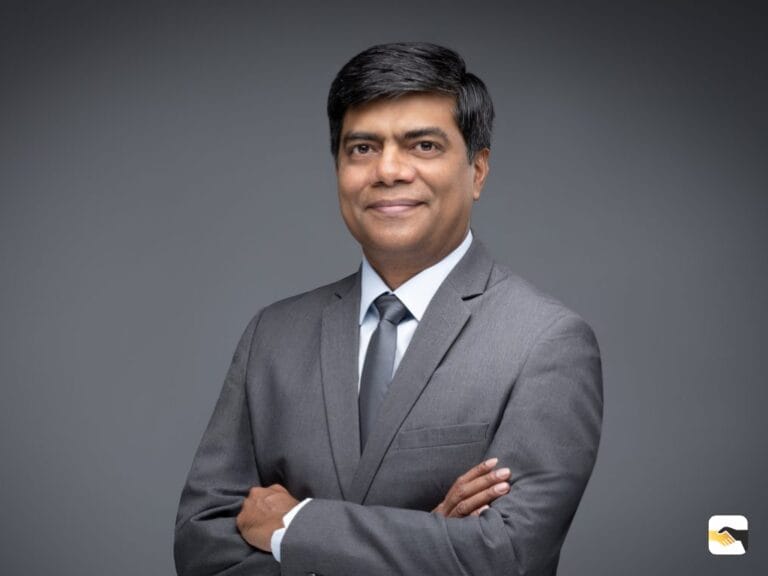
Sumanta Roy, Head of Middle East and Africa, reflects this philosophy. He believes in going beyond mere technological transformation. “We don’t just deliver solutions; we enable a shift in mindset. We ensure that our clients are equipped for long-term digital journeys,” says Sumanta.
Transforming Business Through Purpose-Driven Technology
Sumanta emphasizes that digital transformation is no longer confined to IT departments. Every department and business function must adopt a digital-first approach. TCS ensures that businesses understand and implement transformation holistically – from strategy to execution to future-readiness.
According to the 2023 TCS Digital Twindex report, digital twin technology will become commonplace in homes, governments, and businesses by 2035. TCS is already preparing its clients for this future.
A Journey Spanning Continents and Contexts
Sumanta’s journey at TCS spans more than 30 years. After a brief stint in entrepreneurship, he joined TCS through campus placement. From testing software products to leading sales for Indian SMEs and expanding into neighboring countries, his journey has been marked by adaptability.
He served as product manager during the Y2K era, then moved to the US to lead regional sales. Later, he took charge of TCS’s IT procurement division during its landmark IPO. Shifting roles again, he moved back to sales, this time leading BPO initiatives on the East Coast. Over time, he also oversaw utilities and all India sales before relocating to Dubai in 2019 to lead operations in the Middle East and Africa.
A Leadership Style Rooted in Clarity and Empathy
Sumanta leads with flexibility and a focus on three priorities: customer satisfaction, financial management, and team growth. He practices “coaching leadership,” maintaining an open-door policy while empowering his team to take ownership. Storytelling plays a significant role in his communication style, which he uses to connect, guide, and inspire.
One of his biggest leadership tests came during the COVID-19 pandemic. Navigating varied customer needs and national challenges, he returned to the company’s mission and values. “Empathy was our compass,” he recalls.
He also recounts a difficult but principled decision to exit a challenging market in Africa, prioritizing brand integrity over short-term revenue. “We made a calculated choice. Our brand value was too important to compromise,” says Sumanta.
Strategic Growth in the Middle East & Africa
TCS has built a strong presence in the Middle East and Africa, with more than 150 clients and significant growth in talent. Over the last three years, the company has increased its workforce in the region by over 50 percent, partnered with governments and startups, and grown its customer base across various sectors.
TCS also fosters innovation through partnerships with academic institutions like UAE University, KAUST, and the Mohammed Bin Rashid School of Government. Programs such as TCS Sustainathon and innovation labs in Riyadh promote local problem-solving using advanced technology.
The All Women Digital Services Centre, launched in Riyadh in 2013, is another hallmark. It now employs nearly 1,000 Saudi women, demonstrating TCS’s commitment to inclusion and empowerment.
TCS’s sponsorship of global marathons and partnerships like Formula E underscore its commitment to sustainability. Using data and AI to drive performance in sports is a reflection of its vision: sustainable innovation that benefits both businesses and society.
Looking Ahead
Sumanta believes that the future will be shaped by organizations that remain grounded in purpose while navigating constant change. “Technology is only part of the equation. What matters most is how we use it to build a better, more sustainable world,” he concludes.